Wednesday, 30 September 2015

U.S. military launches airstrike on Kunduz after Taliban assault on the key city

September 29 2015

Stunned by a dawn attack from three sides, Afghan troops are engaged in a desperate counter offensive to regain control of the city of Kunduz, in northern Afghanistan. 

KABUL — Afghan forces struck back Tuesday in the besieged northern city of Kunduz, opening potentially risky street-by-street battles seeking to drive back Taliban fighters and reverse a humiliating blow to Afghanistan’s Western-backed government. 

But the counteroffensive met stiff resistance from Taliban units near the airport on the city’s outskirts, touching off intense clashes that blocked Afghan troops from making a push toward the heart of Kunduz. 

The showdowns took shape before dawn — less than 24 hours after Taliban militiamen stormed into Kunduz — as Afghan reinforcements poured into the area after a U.S. airstrike helped clear the way. 

The fight to reclaim Kunduz — Afghanistan’s sixth-largest city and a strategic gateway to Central Asia — serves as one of the Afghan military’s biggest tests in the 14-year-long war against the Taliban insurgency and raised questions about the withdrawal timetable for U.S. and other coalition troops. 

It also unfolds in a new and challenging backdrop: an urban setting where hundreds of thousands of civilians are holed up in their homes. The Taliban’s white flag was hoisted over major government buildings. 

A spokesman for the international military coalition in Afghanistan said the U.S. air attack sought to “eliminate a threat to the force.” Coalition officials did not specify the target or whether the airstrikes will be followed up by others. 

Safiullah Ahmadi, a Kunduz official who is helping to oversee the government response, said in an interview that Afghan forces have retaken the Kunduz police station, which the Taliban seized along Monday. 

Kunduz police reported that they regained control of the city prison, where more than 600 prisoners escaped during the Taliban blitz.

But Ahmadi said that Taliban fighters still control large swaths of the city and that “a big operation” was needed to dislodge them. He said warplanes were in the area, but “we would like not to rely on air power in order to avoid civilian casualties.” 

Mirza Laghmani, a Kunduz resident, said “intense fighting” raged near the Kunduz airport, and government forces were facing ambush-style attacks by the Taliban on roads leading into the city center. 

Meanwhile, casualties mounted. The aid group Doctors Without Borders said its trauma hospital in Kunduz has been “inundated” with more than 170 injured patients, including many suffering from gunshot wounds. 

The U.S. military still has 9,800 troops in Afghanistan, but it was unclear whether any American personnel were stationed near Kunduz, about 150 miles north of Kabul. 

Defense officials predicted that Afghan forces, including commandos and special forces, would quickly expel the estimated 500 Taliban fighters. 

But many analysts said the Taliban advance demonstrates that Afghanistan still lacks basic command-and-control procedures for managing its 352,000-member military and police forces. 

Afghan police officers stationed in Kunduz, for example, are thought to have simply abandoned their posts. Questions were also mounting over why more army personnel had not been stationed in Kunduz, which the Taliban had attacked twice this summer. 

Taliban fighters looted banks and office buildings on Tuesday, according to a local police official. Pictures were circulating on social media showing Taliban fighters riding around in Red Cross vehicles. 

Other images showed Taliban fighters gathered around an old Russian-made tank, probably left over from the Soviet occupation of Afghanistan in the 1980s. One militant ripped off a round of celebratory gunfire. Another barked at him to stop. 

“Do not waste the bullets and create fear,” he said. 

Billboards depicting slain and current anti-Taliban commanders were torn apart. 

The Taliban’s success in seizing the city was a crushing setback for Afghan President Ashraf Ghani, who is struggling to manage the biggest crisis of his year-old presidency. 

“This incident will embolden the Taliban,” said Sher Mohammad Akhundzada, an Afghan senator from Helmand province, where the Taliban controls large swaths of territory. “This government should resign. . . . We had warnings about the fall of Kunduz. No one listened.” 

At a news conference in Kabul, Ghani defended the military response to the crisis, saying the Taliban had infiltrated the city disguised as civilians. They hid in houses and suddenly burst out early Monday, quickly overwhelming security officials, who struggled to differentiate between militants and residents, Ghani said. 

“The problem here is that a traitor enemy had turned the local population into a shield,” he said. “The government of Afghanistan is a responsible government and can’t and won’t bomb its people, its countrymen, inside a city.” 

In a sign of the strain facing the government, the country’s second-ranking leader, chief executive Abdullah Abdullah, announced that he was leaving the U.N. General Assembly in New York earlier than planned and heading home. 

“Afghanistan is suffering, and its people demand solutions that are practical, verifiable and durable,” Abdullah said in his U.N. address on Tuesday, appealing specifically to neighboring Pakistan to crack down on the Taliban and other militant factions. 

In Washington, the fall of Kunduz is raising new questions about President Obama’s pledge that he will withdraw all remaining U.S. troops from Afghanistan over the next 16 months. 

Pentagon leaders have indicated that they may ask Obama to slow the planned drawdown. 

“The fall of Kunduz to the Taliban is not unlike the fall of Iraqi provinces to ISIL,” said a statement from Rep. Mac Thornberry (R-Tex.), chairman of the House Armed Services Committee, using one of the acronyms for the Islamic State militant group. 

“It is a reaffirmation that precipitous withdrawal leaves key allies and territory vulnerable to the very terrorists we’ve fought so long to defeat,” he added. 

Sen. John McCain (R-Ariz.), a frequent critic of Obama’s strategy in Afghanistan, issued a statement comparing the fall of Kunduz to rise of Islamic State militants in Iraq. 

“It is time that President Obama abandon this dangerous and arbitrary course and adopt a plan for U.S. troop presence based on conditions on the ground,” said McCain, who chairs the Senate Armed Services Committee. 

Kunduz was just one of several flash points on Tuesday. 

In Nangahar province in eastern Afghanistan, local officials reported that hundreds of Islamic State militants attacked several outposts but were repelled. Meanwhile, Taliban fighters appeared to threaten numerous small cities in Baghlan province, which borders Kunduz province. Kunduz city is the provincial capital. 

Haroun Mir, founder of Afghanistan’s Center for Research and Policy Studies, predicted that Afghan forces would quickly recapture Kunduz. 

Despite its rapid advance on Monday, Mir said, the Taliban is still not a fighting force that is equipped to defend ground for extended periods. The Taliban already appears to be ferrying looted ammunition, military vehicles and computers out of the city, local officials said. 

“They are loading up trucks with stolen goods to carry them to their stronghold, because they know they can’t stay in Kunduz city much longer,” said Sultan Arab, a local police commander. 

Still, Mir said, “the damage is already done.” 

“Who is responsible for this — the governor, the police chief, military leaders — is still not clear,” he said. “But it’s clear what happened in Kunduz can happen anywhere. It can even happen in a city such as Kabul.” 

Murphy reported from Washington. Mohammad Sharif and Sayed Salahuddin in Kabul and Daniela Deane in London contributed to this report.

Afghanistan and “Failed State Wars”: The Need for a Realistic Transition

SEP 29, 2015 

The Taliban’s capture of Kunduz does mark its first major capture of a major urban area, but it is only a symptom of a much broader crisis in the Transition process in what has begun to approach a forgotten war. 


Afghanistan and the Defeat in Kunduz: The Crisis in Transition

SEP 29, 2015 

The Taliban’s capture of Kunduz does mark its first major capture of a major urban area, but it is only a symptom of a much broader crisis in the Transition process in what has begun to approach a forgotten war.

The Broader Crisis in Afghanistan and a Failed Transition Plan

Afghanistan is now caught up in a much broader series of crises: political, governance, economics, security, and Afghan force development. In each case, the “Transition” since U.S. combat forces left at the end of 2014 is failing.

This failure is only partly the fault of the Obama administration. The Afghan government has failed to provide effective leadership in each critical dimension. Many of the problems involved also have their origins in the UN’s failure to play a meaningful role in coordinating any aspect of the civil aid effort, and the erratic politics and programs the Bush Administration pursued – partly because of its focus on the Iraq conflict. .

The fact remains, however, that it is the Obama administration that is now in charge and that created a fundamentally unworkable set of transition policies and deadlines. It is the Obama administration that set transition deadlines for the political purpose of ending the war before the president left office, rather than created plans based on the conditions in Afghanistan and real world level of civil and military development in the country.

It is the Obama administration that steadily cut back on the level of reporting and transparency in the transition process, made exaggerated claims of success, and avoided dealing with problems by failing to address them and the data on their scale and seriousness. It is also only the Obama administration that has the option of reversing its mistakes in time to have any real hope of salvaging the transition process.

These are key issues the Congress must address as it starts to hold hearings on the progress in Afghanistan, and it must look far beyond the military and security dimension. This is made clear in detail in a new report by the Burke Chair at CSIS that uses a wide variety of official, NGO, and think tank data and metrics to address each critical problem in Transition.

This report is entitled Afghanistan and “Failed State Wars”: The Need for a Realistic Transition, and is available on the CSIS web site athttp://csis.org/files/publication/150929_Cordesman_Afghanistan_Failed_State_Wars_1.pdf.

The report is in PowerPoint form so it can show the trends involved in graphic and map form, and provide comparative data from a wide range of sources.

The Crises in Politics, Governance, and Economics

The first part of the report focuses on the political, governance, and economic crises in Afghanistan because these aspects of transition have received far too little attention from the administration, the Congress and outside analysts.

It addresses: 
The reality that the problems in host country leadership and governance have often been as much, or more, of a threat to success as the actions of the Taliban and other insurgents. (pp. 2-6) 
The fact that Afghanistan faces major crises from population growth and demands for economic success and jobs by its youth – an age group that often turns to violence when the Afghan economy fails to provide real options – and from deep ethnic and sectarian divisions. (pp. 7-17) 
The scale of the real world challenges in civil society and human development, many of which have been concealed or omitted in State Department and USAID reporting. (pp. 18-29) 
Key failures in Afghan politics and governance at every level that have undermined popular support for the government and empower the Taliban and other insurgents. (pp. 30-35) 
The problems caused by massive levels of corruption at every level of civil governance and in the Afghan security forces. (pp. 36-43) 
Critical problems in raising Afghan government revenues, over-dependence on aid, and the ability to formulate and execute the government budget with adequate fiscal controls and measures of effectiveness. (pp. 44-56) 
Broader economic problems which have been disguised in the past by 

o Deep structural problems, gross over-dependence on poorly controlled aid and military spending, and unkept promises of reform, (pp. 57-82)

o Weak job creation and a return to growing poverty (pp. 83-89), erratic economic aid projects poorly executed and with minimal benefits, and serious structural problems in the balance of trade and financial sectors. and

o false promises of a “new silk road” and income from mines and minerals (pp. 90-102),

The failure of counter-narcotics programs from 2002-2015, and a sharply growing dependence on a narco-economy – disguised in part by exaggerated claims of success in eradication and seizures and a failure to honestly assess the real world role of narcotics in the Afghan GDP and economy. (pp. 103-123). 

The Crises in Security and Developing Effective Afghan Forces

The second part of the report focuses on security issues and the effort to create effective Afghan National Security Forces – an efforts whose critical failings have helped create the crisis in Kunduz and a much broader crisis in security that the Obama administration can only address by reversing its current transition plans and policies.

It addresses: 
The fact that violence and casualties are steadily rising, and that the surge in Afghanistan – unlike the combination of the surge and rise of local Sunni forces in Iraq, came too late, was poorly executed, and DoD and UN metrics show it had no meaningful benefits for Afghan security. (pp. 124-135) 

The failure to address the most critical metrics of an insurgency: The relative level of insurgent influence and control versus that of the Afghan government, and the fact that unclassified reporting on this subject began to lie by omission after the trends continued to be negative in 2010. (pp. 136-142) 

The fact that the trend in civilian casualties warns that USG and DoD reporting has systematically understated the growth in the scale and breadth of Taliban and insurgent operations in the past. (pp. 143-159) 

The uncertain status of the development of Afghan Army. Police, and Local Police forces, which has been disguised in part by suddenly classifying the capability of given combat units and police elements, but clearly reflects the lack of progress in creating an effective Ministry of Defense and Ministry of the Interior caused by the long post-election crisis in forming an effective Afghan government. (pp. 160-171) 

The failed and premature Transition Plan that did not provide adequate support for any element of the ANSF, reflect the combat conditions on the ground, cut the advisory efforts at the most critical level of combat operations, and now fails to provide adequate advisory support for the Afghan National Army and police forces thrust into paramilitary roles for which they are not properly trained and equipped. (pp. 173-179) 

The fact that the actual manning levels to support Afghan forces are very low, and the U.S. portion is only about two thirds of the U.S forces deployed in the spring of 2015. No reporting or plan has been released showing current and currently planned levels for end-2015, 2016, or 2017. (pp. 180-186) 

The failure to take the lack of progress in developing the Afghan Air Force into account, although air power offers the only clear solution to partial compensation for the limited size and capability of Afghan ground forces, and the severe limits to the air support provided by U.S. and allied air units since 2014. This has occurred in spite of the fact that air power was critical to avoid Taliban victories when U.S. and allied combat ground troops were still in Afghanistan. (pp. 187-191) 

The erratic nature of U.S. military and civil aid plans and funding from 2002 to the present, coupled to major failures to establish adequate civil plans, the coordination of different national aid efforts, sustain funding levels over time, and develop meaningful measures of effectiveness. (pp. 192-200) 

The fact that Pakistan in many ways remains as much of a threat as an ally. (pp. 201-214) 
The security challenges that might be met if the U.S. expanded its train and assist mission and shifted its focus to combat effectiveness rather than force generation and sustainment, provided adequate combat and other air support, and developed a clear longer-term civil and military plan tied to conditions that the Afghan government and forces could actually meet. (pp. 215-219) 

Radically Change the Transition Plan or Accept Near-Certain Failure

This latter point is critical. The present U.S. Transition effort cannot succeed and the U.S. cannot eliminate its military aid mission by end-2016. There also are no guarantees that the U.S. can now help the Afghan government overcome all of its weaknesses and to succeed.

However, the Taliban and other insurgent elements are not united or so strong that the Afghan government and forces cannot counter and defeat them over time if the U.S. develops a realistic transition plan, provides a condition-based level of train and assist effort and develops realistic civil and military aid plans.

Anthony H. Cordesman holds the Arleigh A. Burke Chair in Strategy at the Center for Strategic and International Studies (CSIS) in Washington, D.C.

Commentary is produced by the Center for Strategic and International Studies (CSIS), a private, tax-exempt institution focusing on international public policy issues. Its research is nonpartisan and nonproprietary. CSIS does not take specific policy positions. Accordingly, all views, positions, and conclusions expressed in this publication should be understood to be solely those of the author(s).


Afghanistan and “Failed State Wars”: The Need for a Realistic Transition

SEP 29, 2015 

The Taliban’s capture of Kunduz does mark its first major capture of a major urban area, but it is only a symptom of a much broader crisis in the Transition process in what has begun to approach a forgotten war. 


CHINA, US COME TOGETHER ON AFGHANISTAN; WHERE IS INDIA?

September 27, 2015


NEW DELHI: While Indian Prime Minister Narendra Modi was busy entertaining corporate heads in New York, and flying to Silicon Valley to visit the Facebook headquarters, a very important, substantive, and significant meeting was held on the sidelines of the UN General Assembly at New York that heralds a major change in the power politics of Afghanistan. 

The U.S.. China and Afghanistan co-convened a high level meeting on Afghanistan’s peaceful development and regional cooperation.Months of efforts by both Pakistan and the U.S. to ease out differences and bring China on board finally bore fruit, with the first-of-its-kind meet being held on the sidelines of the United Nations General Assembly. 

In the chair were the Chief Executive of Afghanistan Abdullah Abdullah, U.S. Secretary of State John Kerry, Chinese Foreign Minister Wang Yi, and Afghan Foreign Minister Salahuddin Rabbani. Those who participated in the talks were ministers from Turkey, Saudi Arabia, Iran,Australia, Italy, Norway.Kazakhstan. Pakistan was represented by National Security Advisor Sartaj Aziz. There was no sign of India, clearly not even invited as a participant. 

The meeting: 

1. expressed its strong support for the National Unity government in Afghanistan; 

2. welcomed steps taken to implement the reform agenda; 

3. reiterated support for an Afghan led and Afghan owned peace process; 

4. supported government efforts to further advance reconciliation with the Taliban and other armed groups; 

5. called upon these groups to enter into direct talks with the Afghan government; 

6. China, US and Afghanistan reiterated their conviction that Afghanistan will never be used as a safe-haven for international terrorists and called for regional and international cooperation on this. 

The next major events will be a donors conference in Brussels, and what was discussed and commended at the meeting, the Heart of Asia-Istanbul Process Ministerial Conference in Islamabad. All present hoped that this would renew a commitment for peace and non-interference in Afghanistan’s regional affairs. 

China has thus stepped in where India seems to have been afraid to tread. In that it has expanded its role from economic and financial assistance to a clearly strategic partnership, sitting on the same side of the table as the US on this issue. In the process that India, which seems to be happy with the “fondness” that the common Afghan reportedly has for Indians, is now completely out of the picture as even two major competitors join hands to tackle the challenges posed by Afghanistan, and the fast deteriorating situation there. 

India’s strategic---if it can be called that---is limited to exchanging dossiers on terrorism with Pakistan, and threatening war through media channels every other day. The absence of dialogue, or as a senior retired diplomat said, even basic strategic thinking has pushed India out on the periphery with even that position----as the meeting above indicated--now under serious threat. 

PM Modi’s visit to the US this time wove itself around investment, with the occasion providing a great photo opportunity. However, except for promises little of substance was placed on the table, well placed sources said, to convince American business that the bottlenecks will be removed at break neck speed, which is what most of them reportedly insisted on. 

The strategic agenda, if it existed, was barely visible during this visit by PM Modi even as Chinas premier Xi Jianpung on his first state visit to the US moved out of the ‘grand events” frame for an itinerary that was broad based, substantive and strategic. The focus points of his discussions with US President Barack Obama and top officials were cybersecurity where gaps were narrowed, climate change that remains with both still on the same page although with differences, South China Sea where there has been little breakthrough as yet, all under the enveloping blanket of Xi’s avowed aim to develop a “great power relationship with the US. 

The cooperation on Afghanistan with China now sharing the grand high table with the US is clearly a major move forward in this direction. China’s interest in Afghanistan shifted from the financial to the strategic about two years ago according to experts here. In fact the Wall Street Journal taking first note of the shift wrote: During Afghanistan’s tumultuous political transition last year, Chinese security officials began visiting Kabul regularly, and expressed concerns about militant havens, according to a former senior Afghan security official. 

Franz-Michael Mellbin, the European Union envoy to Afghanistan, said he first noticed increased Chinese interest in Afghanistan in 2013. “They have been looking for an area to expand their foreign policy toolbox,” he said, “but also doing it in a way that would not be seen strategically threatening to the U.S.” 

During an October conference on Afghanistan in Beijing, a Chinese general surprised some U.S. participants by suggesting the Pentagon inquire about a joint effort with China to train Afghan security forces, say people familiar with the matter.” 

This was followed by a secret meeting of the Taliban in China in May this year, with the news being leaked at the time to the Wall Street Journal in the US. Top officials from Afghanistan and Pakistan were present at the meeting, that really became the turn point for full blown Chinese participation in the Afghan peace process. The US has been in close contact with Beijing with Secretary of State John Kerry speaking highly of the new found cooperation with China at the New York meeting just a day ago. He went on to describe China “as a country that understands very deeply the cross currents in Afghanistan. 

Relations between China and Pakistan are close and strategic, leading to discomfort in New Delhi and also Washington, that the latter has clearly overcome. The Wall Street Journal quoted Hu Shisheng, an Afghanistan expert at the China Institutes of Contemporary International Relations, a think tank linked to the Ministry of State Security saysing that the training of Afghan forces outside Afghanistan by both US and China was seen as “feasible and realistic.” The two countries are jointly training diplomats as well. 

Pakistan is supportive, with a foreign ministry statement from Isalamabad maintaining earlier that the Sharif government will work closely with China to support the Afghan peace process. US media reports also suggest a lowering of tensions with senior officials being quoted as saying that they do not see China as a competitor to its relations with Afghanistan and Pakistan. The major meeting in New York was a clear example of this major shift in policy, with close coordination being the key word even as India is eased out. Or as a source said, eases itself out of the Afghan peace process altogether.


Taliban overrun Afghan city of Kunduz

28 September 2015 

Out of media player. Press enter to return or tab to continue.Media captionFootage showed prisoners, freed by the Taliban, running out of the prison in Kunduz

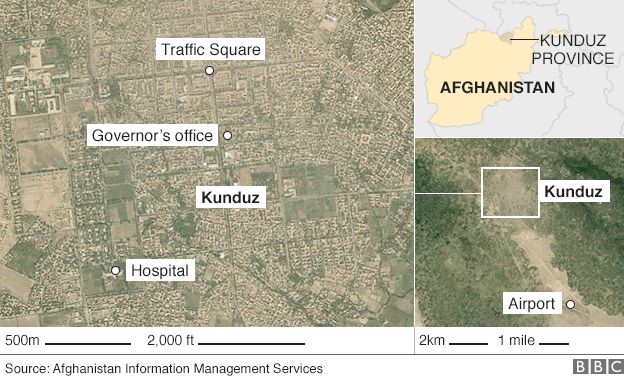
The Taliban have overrun the northern Afghan city of Kunduz, taking control of most areas and freeing hundreds of prisoners from its jail.

Hundreds of militants stormed the city before dawn, quickly seizing key buildings and advancing on the airport.

The government says it has sent reinforcements to Kunduz and fighting is ongoing.

Kunduz would be the first provincial capital taken by the Taliban since they lost power in 2001's US-led invasion.

The attack came a day before the first anniversary of President Ashraf Ghani's unity government.

Kunduz is strategically important as it acts as a transport hub for the north of the country.

It also has symbolic significance for the Taliban as it was their former northern stronghold before their government was overthrown.

"With the capturing of the police compound and governor's office in Kunduz, the whole province fell to our hands and our fighters are now advancing towards the airport," Taliban spokesman Zabihullah Mujahid said on his Twitter account.Image copyrightAPImage captionSmoke at a police station in Kunduz. The province has seen a number of attacks since AprilImage copyrightAPImage captionPrisoners freed by the Taliban were seen walking through the streets of KunduzImage copyrightAFPImage captionThe government says its forces in Kunduz are being reinforced

A picture on the same account purportedly showed fighters at a roundabout in the city centre raising the Taliban's white flag.

Later, interior ministry spokesman Sediq Sediqqi confirmed that "most of Kunduz city" was controlled by the Taliban, and said Afghan forces were regrouping at the airport.

A Taliban statement called the operation in Kunduz "an immense conquest" and urged their fighters to protect the local population.

The statement said the government in Kabul "should openly admit its defeat".

Earlier, the government admitted that it had lost control of parts of the city. It said at least 25 militants and two Afghan policemen had been killed and that reinforcements had been dispatched.
Analysis: Dawood Azami, BBC World Service

This attack is one of the most serious security breaches since the start of the Taliban insurgency 14 years ago. But the Taliban's main challenge will now be to hold the city.

Kunduz has a huge strategic significance as it is considered a gateway to Afghanistan's northern provinces and shares a border with Tajikistan, Afghanistan's Central Asian neighbour.

The Taliban already control huge chunks of the province's rural areas, where the majority of the population live. The insurgents have intensified their fighting in the province over the past two years.

They are the dominant militant group in the province, with an estimated 2,000 fighters. But there are also reportedly hundreds of foreign fighters associated with al-Qaeda, so-called Islamic State and the Islamic Movement of Uzbekistan (IMU).

The Afghan security forces are stretched thin as they deal with multiple attacks all over the country.

Bad governance in Kunduz is also a key problem. Incompetence and intimidation by some local officials have alienated many in the province.

Kunduz police spokesman Sayed Sarwar Husaini told the BBC's Mahfouz Zubaide that militants had captured the jail in Kunduz and freed about 500 prisoners, including members of the Taliban.

One of the freed prisoners told the BBC: "It was about 4pm when the Taliban entered the jail and started fighting with police. After a few minutes the police escaped and the Taliban fighters opened all the cells and all the prisoners rushed out."

He said he saw Taliban armed with small and heavy weapons in the streets outside.

Media captionThe Afghan government says several militants and two policemen have been killed

Many government officials are said to be trying to flee via the city's heavily fortified airport.

Kunduz province has seen a number of attacks since April, with the Taliban joining forces with other insurgents.

Militant violence has increased across Afghanistan since the departure of most US and Nato forces last year.Image copyrightReutersImage captionResidents fled parts of the city as the fighting raged

A de facto partition for Afghanistan

By ROBERT D. BLACKWILL 

After years of faulty U.S. policy toward Afghanistan, there are no quick, easy and cost-free ways to escape the current deadly quagmire.

The Obama administration’s counterinsurgency strategy in Afghanistan seems headed for failure. Given the alternatives, de facto partition of Afghanistan is the best policy option available to the United States and its allies.

After the administration’s December Afghanistan review, the U.S. polity should stop talking about timelines and exit strategies and accept that the Taliban will inevitably control most of its historic stronghold in the Pashtun south. But Washington could ensure that north and west Afghanistan do not succumb to jihadi extremism, using U.S. air power and special forces along with the Afghan army and like-minded nations.

Story Continued Below

Enthusiasts for the administration’s counterinsurgency strategy, or COIN, are likely to reject this way forward in Afghanistan. They will rightly point out the many complexities in implementing de facto partition.

De facto partition is clearly not the best outcome one can imagine for the United States in Afghanistan. But it is now the best outcome that Washington can achieve consistent with vital national interests and U.S. domestic politics.

There are many reasons for this.

Even if President Barack Obama adds a year or two to his timeline for major progress, the COIN strategy appears unlikely to succeed. Given the number of U.S. combat forces now fighting, the Taliban cannot be sufficiently weakened in Pashtun Afghanistan to drive it to the negotiating table on any reasonable timeline. True, the Afghan Pashtun are not a unified group. But they do agree on opposing foreign occupation and wanting Pashtun supremacy.

“We have seen no evidence that they are truly interested in reconciliation,” CIA Director Leon Panetta said on June 27, “where they would surrender their arms, where they would denounce Al Qaeda, where they would really try to become part of that society. ... Unless they're convinced the United States is going to win and that they are going to be defeated, I think it is very difficult to proceed with a reconciliation that is going to be meaningful.”

With an occupying army largely ignorant of local history, tribal structures, language, customs, politics and values, the United States cannot, through social engineering, win over, in the foreseeable future, sufficient numbers of the Afghan Pashtun on whom COIN depends.

Afghan President Hamid Karzai’s deeply corrupt government — as unpopular as the Taliban — shows no sign of improvement, and Afghanistan has no history of a robust central government. Allied efforts to substitute Western nation building for Afghan nation building will continue to fall short. The Afghanistan National Army is not expected to be ready to vanquish the Taliban for many years, if ever.

Moreover, Pakistan’s military and intelligence services, with their dominating optic of India as the enemy, have shown no willingness to end support for their longtime Afghan Taliban proxies — or accept a truly independent Afghanistan.

Decisively, the long-term COIN strategy and far shorter U.S. political timeline are incompatible.